
Rosa Park’s simple act of defiance on December 1, 1955 has been in America’s conscious for as long as I can remember. But it was not until we visited the Rosa Parks Museum in downtown Montgomery that we fully understand how one brave woman’s refusal to leave her seat set off a series of events that began with a city-wide bus boycott and ended with the Voting Rights Act of 1965.


Fifty miles west of Montgomery, our Civil Rights tour continued in Dallas and Lowndes Counties that in the 1950s and 60s were among the poorest and most repressive for black people in the country. Both counties had gained a national reputation from the rampant racially motivated terrorism and police intimidation, so much so that Lowndes County became known as bloody Lowndes. By 1963, all eyes turned toward the little town of Selma in Dallas County that had become a hotbed of civil rights turmoil.

“The blacks are too scared and the whites are too mean.”, reported John Lewis founder of the Student Nonviolent Coordinating Committee (SNCC) after a scouting trip to Selma. Nevertheless, SNCC came to Selma where the voting roll was 99% white and 1% African American to organize voting registration for its black community.


“It’s because of those four little girls that you need to do this.” Said the wife of the Hosea Williams, pastor of Brown Chapel in Selma, when her husband first resisted making his church the meeting place for organizers given the recent bombing in Birmingham that killed four children on September 15, 1963. The pastor listened to his wife and as SNCC attempted to mobilize the community to register to vote, the voter application denials increased and so did the violence.

The Alabama River runs through Selma and two sides of the town are connected by The Edmund Pettus Bridge. When Vivian and I visited Selma on our Civil Rights tour of Alabama, the historic bridge’s name was not lost on us. Pettus was a Confederate general, U.S. Senator and Grand Dragon of Alabama’s Ku Klux Klan.

Vivian and I walked across the Edmund Pettus Bridge in the same direction as 400 civil rights marchers did on March 7, 1965. We tried to imagine what the marchers were thinking as they began walking to the top of the bridge, unable to see what was waiting for them on the other side. We imagined what ran through their minds as they crested the top of the bridge 100 feet above the river.

“Do you know how to swim?”, Hosea Williams asked his fellow protestor John Lewis. The brave protestors continued marching toward the wall of state troopers and a posse of men deputized earlier that morning – armed and waiting for the marchers at the end of the bridge.


What happened next became known as Bloody Sunday, the name given to the brutal attack that horrified American and international audiences who watched it unfold on television. The next day, front pages of newspapers displayed images of bloodied and severely injured marchers, including Amelia Boynton who was beaten unconscious and 14-yr old Lynda Blackmon Lowery.

It was the outrage around the country that galvanized the Civil Rights movement. On March 21, 1965, Martin Luther King, Jr led 3200 marchers under the protection of the National Guards and troops from Selma to the capitol building of Montgomery. By the time the marchers reached the steps of the capitol, they were 25,000 strong.
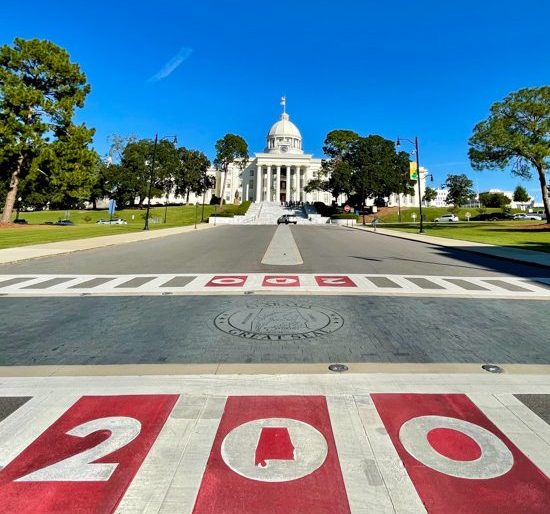

The Voting Rights Act was passed that summer and signed by President Lyndon Johnson on August 6, 1965.

I will end this blog with two photographs I took inside the Alabama state capitol. Three years ago, we visited Eufuala, Alabama where we learned about Horace King. King, born a slave in 1807 became a successful engineer and architect, and then later a member of Alabama’s House of Representatives. It was our pleasure to learn that the beautiful cantilever stairs in the capitol were designed and built by Horace King.


What a tragic and historic time for our country. :_(
LikeLike
Such brave and organized women and men. I didn’t know that so few Blacks were able to register to vote. What a reign of terror. Appreciated your clear, unemotional telling of the history.
LikeLike