
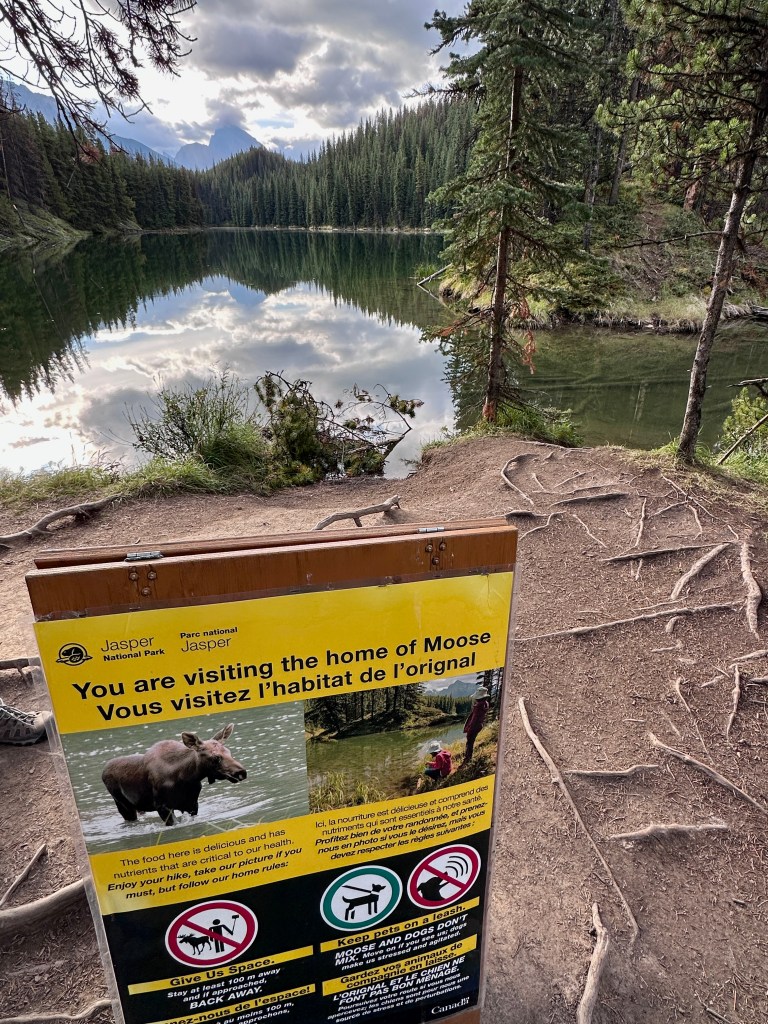
While in Banff and Jasper National Parks, we learned to say ‘Hey bear’ in French. After all, national park signage includes both English and French wording. We added the Spanish version as well because we wanted to make sure a lurking bear could understand us. Learning the Chinese version of “Hey bear” might also have been helpful given the number of Chinese tourists in Banff and Jasper. – “Hey bear”, “Hey ours noir“, “Hey oso negro”. Speaking loud and repetitively, we hiked through the montane and subalpine forests, making sure every bear in ear shot would know our presence. The idea of a bear translating human languages is tongue-in-cheek silliness, but it helped keep us on guard because no matter what language you speak, doing so loudly and frequently may help ward off a serious encounter with a very large mammal that has the potential to kill you.

Of course, we carried bear spray and could access it within a second if needed. It was second nature to grab the canister each time we left the RV to hike around the forest adjacent to the campground and anytime we got in the truck to go somewhere. We never knew where we might go, so we came prepared. Fortunately, we never got close to testing our questionable bear encounter skills – nor did we see a moose or elk on those hikes. In fact, we didn’t see any large animals while hiking. That was no surprise given that encounters with alligators (or any other wildlife including snakes) are infrequent when we wander through the Everglades swamps for miles and it isn’t unusual for someone to say, “you’re lucky if you see one”.
Despite the repellant effect of loud talking on the hiking trail, we did see animals in Banff and Jasper National Parks in a variety of other ways. For example, the dozens of elk hanging out near our campsites became so commonplace we mostly ignored them after a few days. These elk were cows and calves, some youngsters still dependent on mom. Among them were young bulls at least a year old because their antler spikes, which grow an inch per day showed noticeable growth during our 12 days.


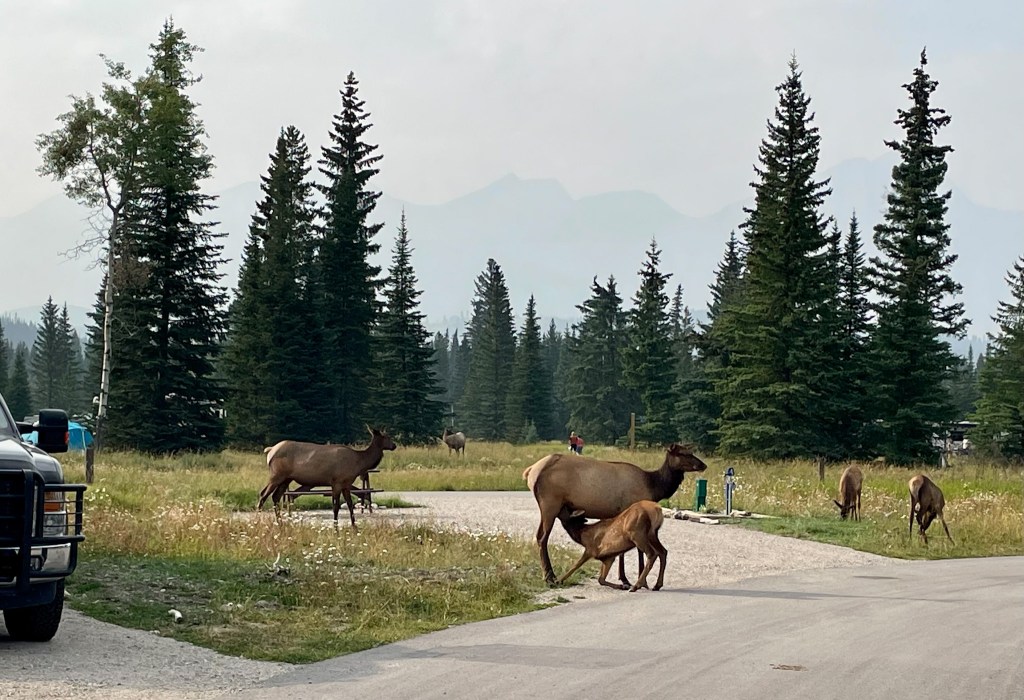

One time, we watched a calf wander around despondently looking for mamma. The high-pitched cries were persistent in the baby’s attempt to get within earshot of mom. The sound of the young elk is like the one its mother makes – squeaky and full of effort, so contradictory to the very large mammal from which it emanates. The adult bull makes a high-pitched bugle sound as well, although more robust with a slightly deeper note and more alarming to the human ear.

Adult bull elks with 12 or 14-point antlers were seen along the road on a few occasions, and safely from our vehicle we could photograph them. Not yet rutting season, bulls were wandering alone, occasionally stopping to sharpen a point or two with a sign post or tree. We visited the parks when elk encounters are less frequent – males not yet in rut, and dependent calves becoming less and less dependent on mom. Nevertheless, we gave the very large animals a wide berth (the park recommends 30 meters).

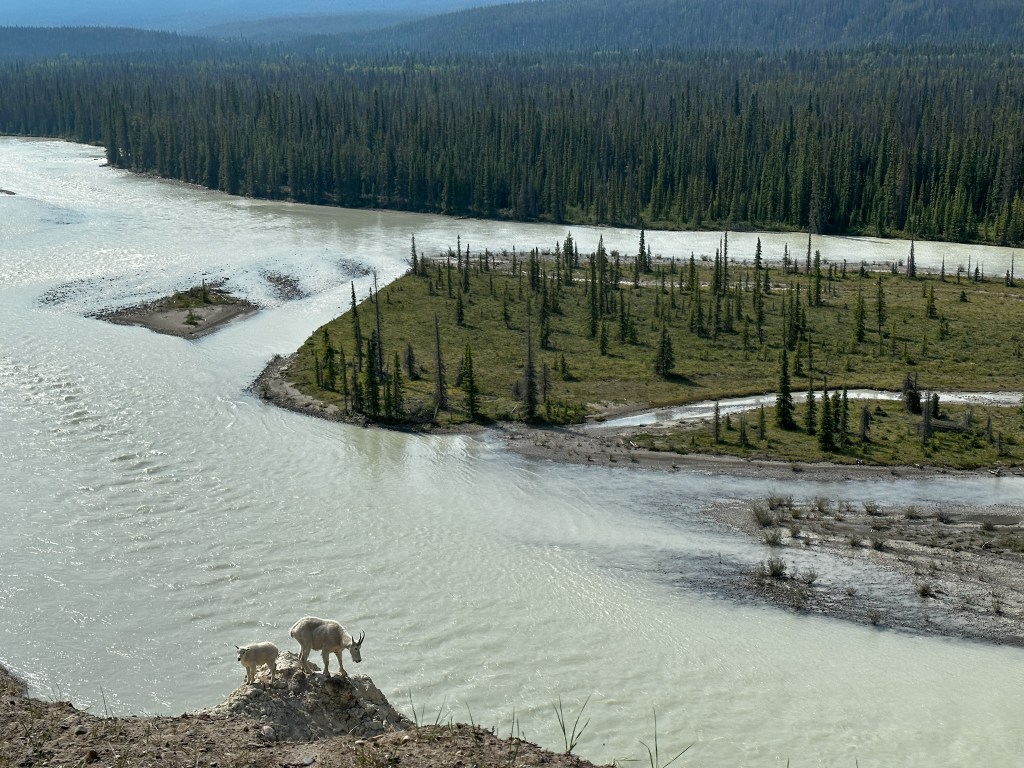
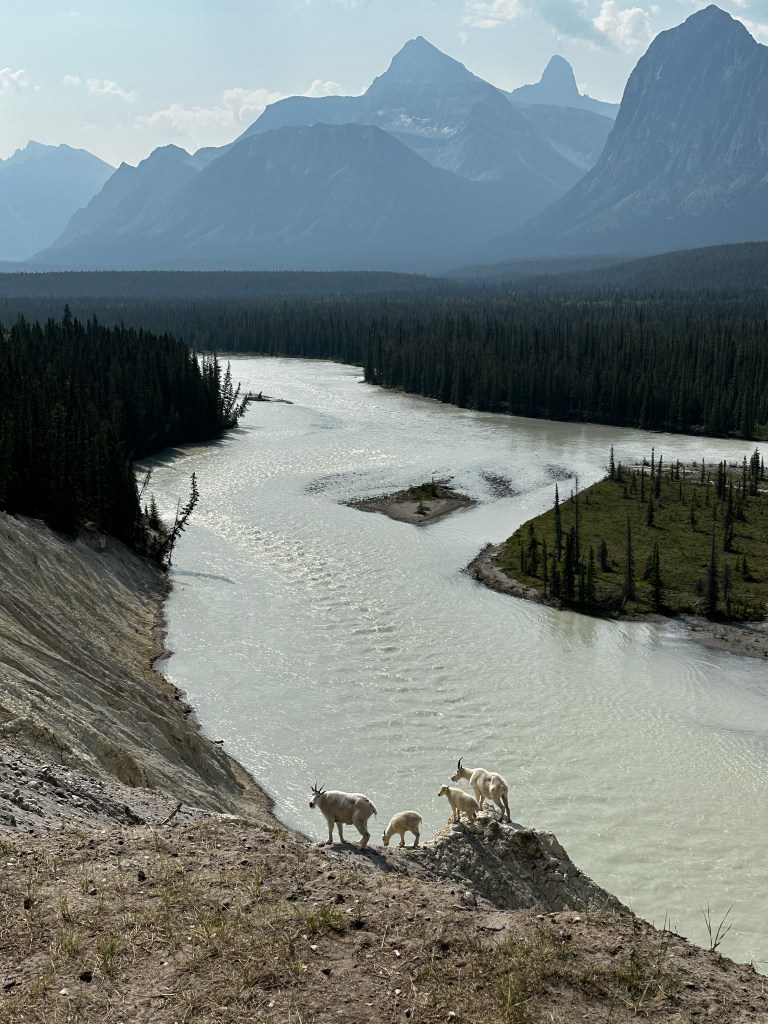
Then there were the mountain goats that appeared out of nowhere on a steep mountain grade while we stood at the Goats and Glaciers Overlook alongside the Icefield Parkway. The two nannies and two kids wandered around for several minutes, long enough for us photograph them with the glaciered mountains and Athabasca River in the background.

On other days, we drove Maligne Lake Road, a popular corridor for roadside wildlife. Traffic jams are not uncommon along this highway. It was there one early morning before the traffic when we spotted a moose slowly crossing the road.
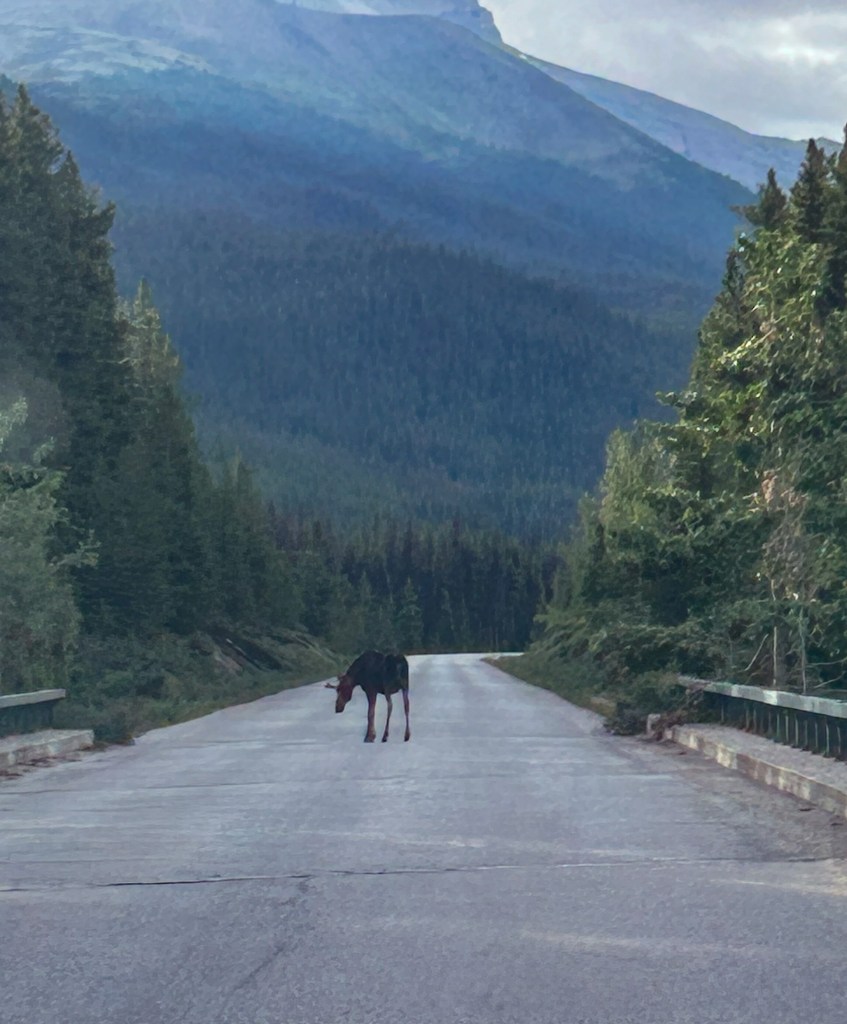
And then there were the fleeting moments we saw a black bear from our vehicle. But no grizzly – not even ‘The Boss’ that had been seen (and photographed) several times earlier in the year near one of the campgrounds.


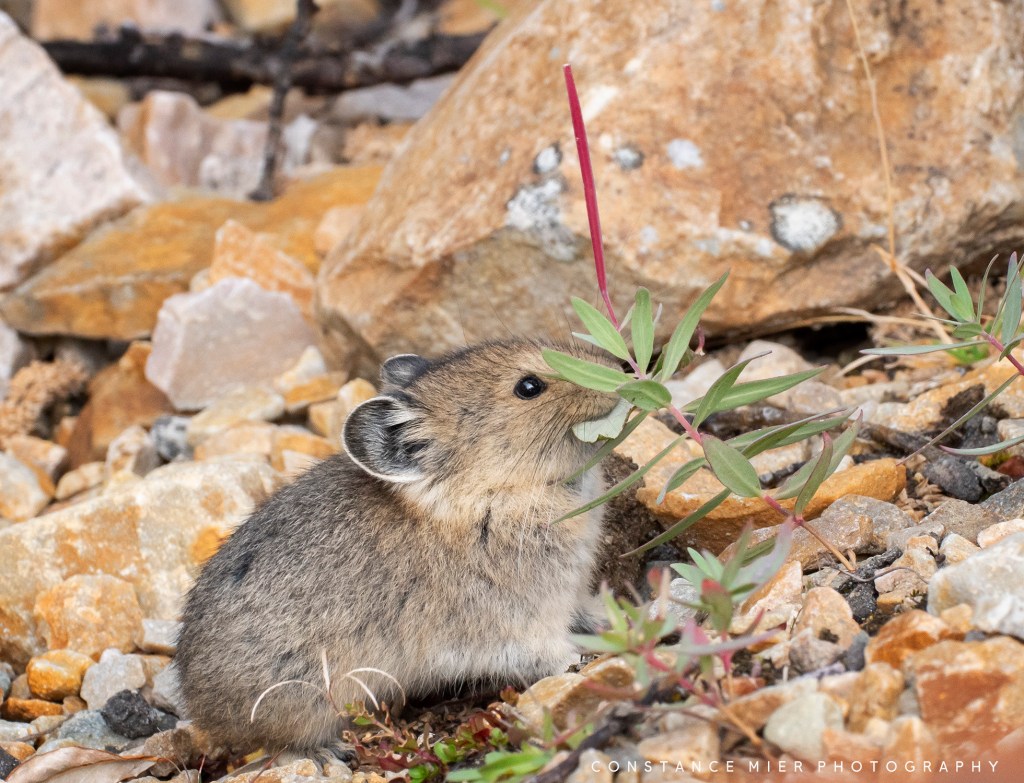
Aside from the large mammals, there were the small ones, the most exotic of which was the pica (pronounced ‘peeka’), foreign to Florida. The American pica looks like a cross between a mouse and a rabbit and is about the size of a hamster. Picas live in rock piles and can be seen scurrying to find grasses and wildflowers to chew on.


Every time we saw a large animal it was a special event that never got old (I still find joy seeing an alligator in the Everglades after having seen hundreds over the years). And here’s why – these animals define the wilderness and are surviving despite our encroachment. They adapt to less space, crossing highways, using hiking trails for traveling, wandering urban areas. Animals are opportunists when it comes to food – where there are people, there is food (such as campgrounds). Consequently, the national parks engage in a balancing act because we want to preserve the wilderness for these animals, but at the same time we want access to them – the crown jewels of Banff and Jasper.
There is one other crown jewel that people come to Banff or Jasper to see – the Northern Lights. I have to share this as I am so proud of our friend Spencer Saints for getting outside late at night (while I was sound asleep) and having a good eye to see the lights, and take photographs! This is from the Whistlers campground in Jasper.

While you’re at it, check out Lorraine and Spencer’s travel blog. Living fulltime in their RV since 2017, they’ve seen it all – or at least they are on an adventure to see it all! And be sure to check out our previous blogs about our time in Banff and Jasper National Parks if you missed them:
Aug 10, 2023 – Jasper National Park Part 2 – The Power of Erosion
Surrounded by towering mountains, everything at eye level becomes insignificant and crowds seem less bothersome. And as you wander down a path through a montane forest while talking aloud to…
Aug 3, 2023 – Jasper National Park Part 1 – The icefields
You might think leaving Banff National Park would not be easy, but the fact we would drive north on Highway 93 toward Jasper National Park made it so. If Banff…
Jul 29, 2023 – Reflections on Banff National Park
When our friends Spencer and Lorraine pulled into the campground, Vivian and I had been in Banff National Park for an entire week. During that time, we did some hiking…
Jul 22, 2023 – Canada’s Emerald City
As cliché as it sounds, driving into Banff National Park’s Tunnel Mountain Trailer Court reminded me of Dorothy walking out of the woods and into the Land of Oz –…

 Changing Views From Our RV
I have never seen so many “squirrels” in all my life! Wonderful memories.
LikeLike